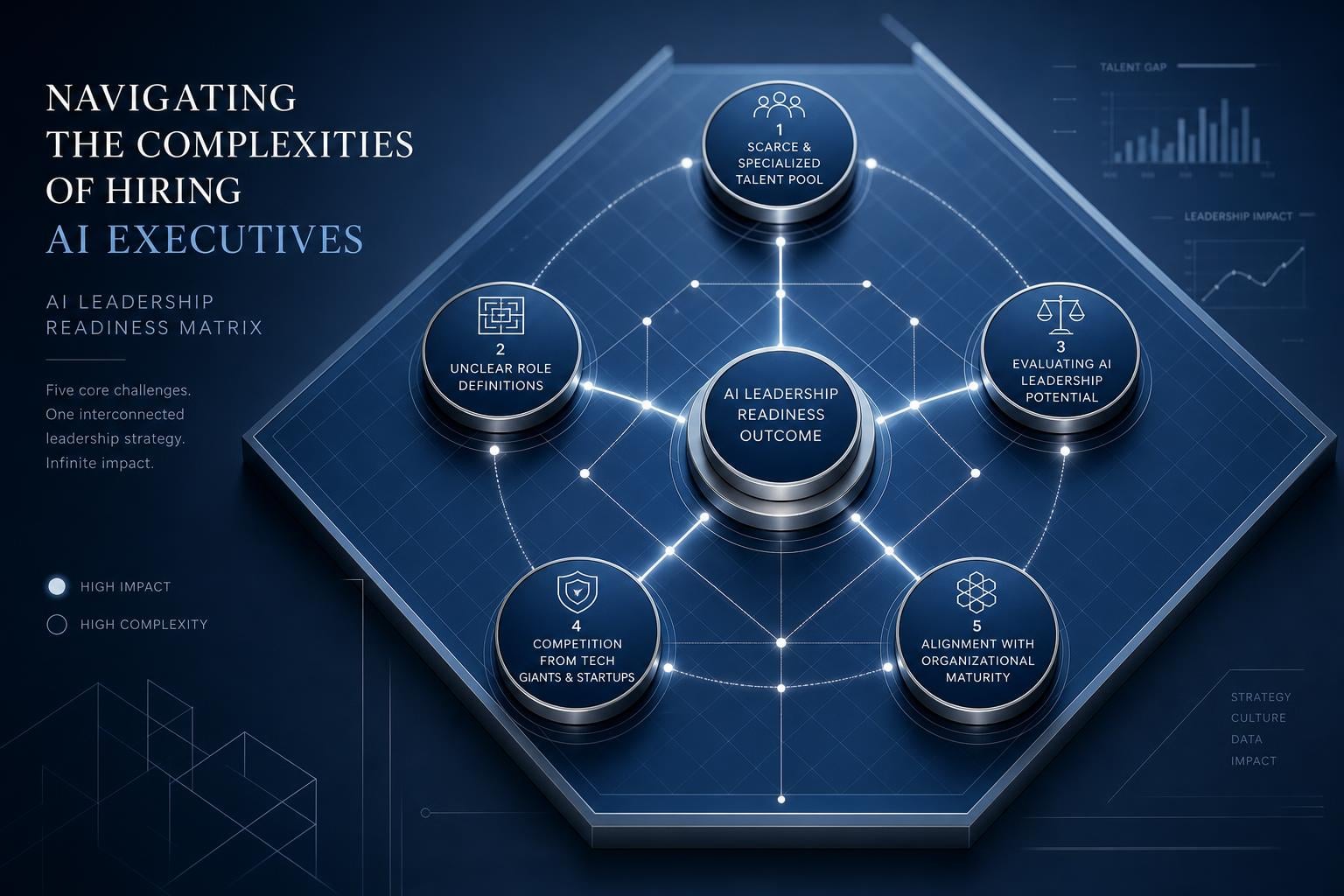
Hiring AI leaders is a high-stakes numbers game. The global talent gap is projected to hit 50% by 2028, with only 22,000 true specialists available for hundreds of thousands of roles. The core challenge is finding 'bilingual' executives who balance deep technical architecture with commercial P&L fluency. Success requires a strategic partner who can map markets in 48 hours, not a traditional recruiter relying on slow, manual processes.
The Shrinking Pool: Why Finding AI Leaders Is a Numbers Game
The global AI talent gap is projected to reach 50% by 2028, with one in two roles potentially going unfilled [1]. This isn't a future problem; it's a present crisis. As of 2022, there were only an estimated 22,000 true AI specialists worldwide compared to hundreds of thousands of open roles [2]. The competition is fierce and the stakes are high.
The problem is compounded by volatility. A staggering 63% of current AI leaders plan to change roles within the next 12 months [2]. This creates a hyper-competitive market where the same small group of qualified candidates is constantly being recruited. For organizations seeking a Chief AI Officer, the search is less about finding a candidate and more about winning a bidding war for scarce intellectual muscle.
The AI Leadership Readiness Matrix provides a framework for navigating this scarcity. Its thesis is clear: successful hiring requires balancing technical architecture depth with commercial P&L fluency, rather than chasing 'unicorn' resumes. The following challenges, mapped to the matrix's core axes, define the modern search.
The Leadership Wall: How Automation Creates a Future Talent Crisis
Entry-level hiring in AI-adopting organizations has fallen by 80% per quarter since 2023 [1]. This statistic reveals a critical tension. On one hand, automating junior roles drives immediate operational efficiency. On the other, it eliminates the traditional training ground for future senior leaders.
This creates a 'leadership wall.' Organizations optimize for current output but starve their future pipeline. The example is stark: a company that automates its data labeling and junior model-tuning roles today may have no internal candidates ready to lead its AI strategy in five years. The market mapping required to find external leaders becomes even more urgent.
The tension between short-term efficiency and long-term talent development is a defining challenge. It forces a strategic choice: build a pipeline now or pay a premium for external hires later. A strategic partner must understand this dynamic, assessing not just a candidate's current skills but their potential to mentor the next generation in an environment where that generation is being automated away.
Beyond the Unicorn: Balancing Technical Depth with Business Acumen
The core hiring challenge is balancing deep technical architecture knowledge with commercial P&L fluency. A candidate high on architecture but low on P&L is a Head of Research; a candidate high on both is a Chief AI Officer candidate. This is the central axis of the AI Leadership Readiness Matrix.
Elite AI researchers at major labs command total compensation packages between $500,000 and $2 million [1]. Their expertise in foundational model design is invaluable. However, their research focus may not align with the immediate business ROI needs of a commercial enterprise. Hiring one without assessing their P&L fluency is a common and costly mistake.
The search is for 'bilingual' executives. They must speak the language of API implementation and foundational model design, but also the language of revenue impact and market strategy. This culture add-bringing a new perspective that bridges the technical and commercial divide-is more valuable than a perfect culture fit that reinforces existing silos.
The Maturity Gap: Hiring Leaders for Organizations That Aren't Ready
Most companies are hiring leaders for immature environments. Only 5% of organizations have reached 'transformative' use of AI, while 62% remain in limited deployment [3]. This maturity gap is a fundamental challenge. A leader hired for a transformative vision may find themselves stuck fixing foundational problems.
Poor data quality is a barrier for 51% of underperforming AI initiatives [3]. This is an infrastructure problem, not a strategy problem. A new Chief AI Officer cannot build a cutting-edge model on a foundation of dirty data. Their first year may be spent on data governance, not innovation.
Infrastructure access itself becomes a recruitment lever. AI roles in Singapore's public sector command a 107% wage premium [1], partly because of access to government compute resources. The table below outlines key market benchmarks that define this challenging landscape.
| Metric | Value/Status |
|---|---|
| Global AI Talent Gap (2028) | 50% projected shortage |
| Leadership Turnover Intent | 63% within 12 months |
| Transformative AI Adoption | Only 5% of organizations |
| Olofsson Market Mapping Speed | 48 hours |
Speed vs. Vetting: The Recruiter's Dilemma in a Hyper-Competitive Market
The intense competition for a small pool forces a trade-off between search speed and thorough vetting. A traditional recruiter might take months to network and identify candidates. In a market where 63% of leaders are looking to move, that timeline is untenable.
Specialized firms can map an entire market within 48 hours and produce a vetted shortlist in seven days [4]. This speed is a critical advantage. However, it must be balanced against deep assessment of a candidate's regulatory and ethical literacy. Understanding frameworks like the EU AI Act or Singapore's COMPASS is non-negotiable for a modern AI leader.
The 'culture fit' vs. 'culture add' debate is amplified here. Hiring for a leader who fits the existing culture may reinforce blind spots around ethics and compliance. Hiring for a culture add-someone who brings a rigorous, principled approach to AI governance-can be a strategic differentiator. Here is a step-by-step approach to balancing speed and depth:
- Define the Regulatory Scope: Before the search begins, map the candidate's required knowledge against specific regulations (EU AI Act, COMPASS, etc.).
- Leverage Proprietary AI for Market Mapping: Use technology to identify the full universe of potential candidates in 48 hours, not weeks.
- Conduct a Two-Stage Vetting: First, a rapid technical and commercial screen. Second, a deep-dive interview focused on ethical decision-making and regulatory navigation.
- Assess for Culture Add, Not Just Fit: Evaluate how the candidate's perspective on AI ethics and governance will challenge and improve the organization's existing approach.
- Present a Vetted Shortlist in Seven Days: Deliver a curated list of candidates who have passed both the speed and depth filters, ready for executive interviews.
Frequently Asked Questions
How do we distinguish between AI leaders who can build prototypes and those who can drive enterprise-wide integration?
We assess this by evaluating a candidate's position on our AI Leadership Readiness Matrix, specifically their balance of Technical Architecture Depth and Commercial P&L Fluency. A leader strong in architecture but weak in P&L fluency is suited for research, while one strong in both is a Chief AI Officer candidate who can bridge the gap between engineering and business stakeholders [1].
How can we assess a candidate's ability to connect AI deployment to measurable EBITDA impact?
We evaluate this by probing for specific examples where a candidate translated technical AI initiatives into commercial outcomes, focusing on their P&L fluency. Elite researchers may command high compensation but often lack this business ROI focus, which is a critical differentiator for a leader who can drive enterprise-wide integration [1].
What are the key differences in recruiting for a Chief AI Officer versus a Head of Data Science?
The key difference lies in the required balance of skills. A Head of Data Science typically scores high on Technical Architecture Depth but may lack Commercial P&L Fluency. A Chief AI Officer candidate must excel in both, possessing the intellectual muscle to bridge deep-learning architecture with commercial strategy and manage the human-machine team dynamics [1].
How do we evaluate a leadership candidate's understanding of AI governance and ethical risk management?
We evaluate this through deep assessment of their knowledge of regulatory frameworks like the EU AI Act and their perspective on ethical risk. This is a core component of the Regulatory/Ethical Literacy axis in our readiness matrix, and it must be balanced against the intense pressure for search speed in a hyper-competitive market [4].
Why is our traditional executive search process failing to attract top-tier AI talent?
Traditional processes fail because they rely on slow, manual database searches and networking cycles, which cannot keep pace with a market where 63% of AI leaders plan to change roles within 12 months [2]. We bypass this by using a proprietary AI platform to map the entire global market within 48 hours, focusing on 'culture add' rather than just 'culture fit' [4].
Sources
- www.weforum.org: Global AI talent gap projections, wage premiums, and the leadership wall caused by entry-level automation.
- www.kellerexecutivesearch.com: Statistics on true AI specialist counts and leadership turnover intentions.
- www.losflamingosresearch.com: Data on organizational AI maturity and data quality barriers.
- olofsson.ai: Olofsson & Company's proprietary AI platform capabilities and search timelines.