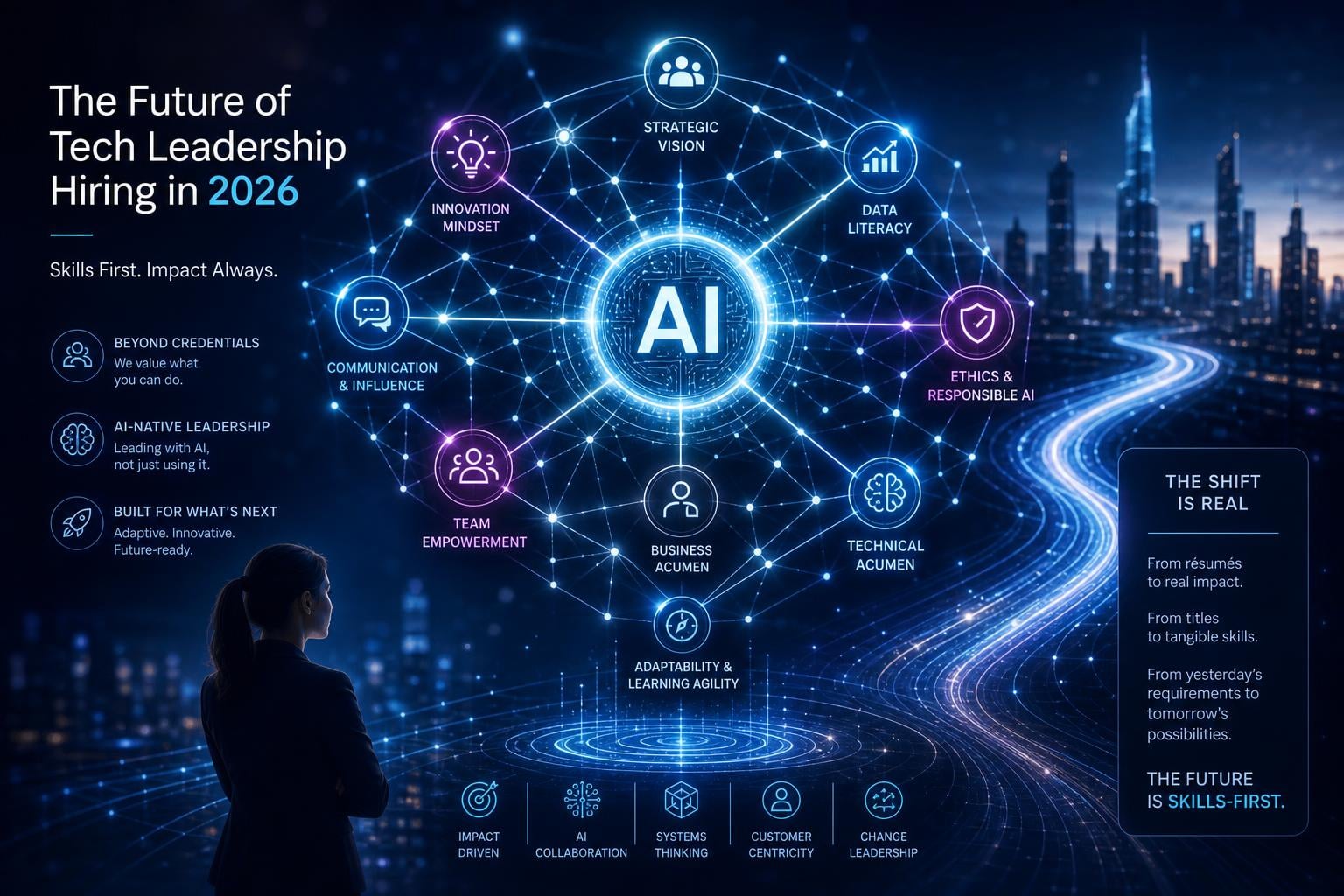
Two things shape technology leadership hiring in 2026. The skills companies most need, AI and machine learning, are the hardest to find. And the cost of a senior hire going wrong keeps climbing. Five shifts follow from that. Fractional and interim leaders are becoming a normal choice. The CTO and CPO roles are merging into a single CPTO. Employers hire on skills more than degrees. AI governance has reached the board agenda. Pay is moving further toward performance. Olofsson & Company, an AI-native boutique that focuses on technology and AI leadership search in Asia and beyond, maps candidate markets in days rather than months and headhunts the passive senior talent these shifts reward.
The 2026 landscape: scarce skills, expensive mistakes
The core problem in 2026 is a gap between what companies need and who is available. The World Economic Forum's Future of Jobs Report 2025 finds that technology roles are the fastest-growing jobs in percentage terms, among them AI and machine learning specialists, big-data specialists and software developers. It also finds that AI and big data are the fastest-growing skill areas for the years ahead [1]. Leaders who can both build with these tools and govern how they are used are rare, and the pipeline behind them is thin.
Scarcity raises the stakes on every appointment. A Leadership IQ study of more than 20,000 hires found that 46% of new hires fail within 18 months, and only 19% achieve unequivocal success [2]. At leadership level the damage from a bad hire runs deeper: lost momentum, a stalled roadmap, and a second search to run. Most of the shifts below are the market's answer to those two problems. Too little of the right talent, and too much riding on each decision.
A boutique is built for this. Olofsson & Company maps a candidate market in about 48 hours and works the passive senior talent that database-led searches never reach, delivering a vetted shortlist in roughly seven days [8]. Speed and precision count for more when the pool is shallow and a mistake is expensive.
Trend 1: Fractional and interim leadership goes mainstream
Interim leadership has moved from stop-gap to plan. Heidrick & Struggles surveyed 3,810 interim leaders for its 2026 Talent Lens report. The share of people newly entering the interim market rose from 6% in 2020 to 15% in 2025, and 42% of interim projects now run longer than six months, up from 27% in 2021 [3]. Interim work is becoming a way to operate, not a pause between permanent jobs.
Risk is what drives it. When 46% of new hires struggle inside 18 months [2], a fractional or interim CTO lets a company bring in senior expertise, steady a function, and test a strategy before it commits to a permanent hire. For scale-ups and companies in the middle of a transformation, the interim leader is often the bridge rather than the fallback.
Trend 2: The CTO and CPO converge into the CPTO
The line between product and engineering leadership is blurring. The search firm Egon Zehnder describes a surge in adoption of a combined role, the Chief Product and Technology Officer, or CPTO [4]. A separate CTO and CPO used to split platform decisions from product and roadmap decisions, and the two sometimes pulled in different directions. A single CPTO puts technical architecture and product strategy under one owner.
For hiring, this sets a higher bar. A credible CPTO has to be fluent in both areas, and that mix is uncommon. It is the kind of narrow, senior profile that rewards mapping the market over waiting for applications.
Trend 3: Skills displace degrees as the hiring signal
Employers increasingly hire for what a person can do rather than what they studied. TestGorilla's State of Skills-Based Hiring 2024 report found 81% of employers using some form of skills-based hiring in 2024, up from 73% in 2023 and 56% in 2022, and 30% of employers removing degree requirements from the process [5]. The relevant AI skills are newer than most degree programmes, so demonstrated work and judgement carry more weight than a diploma.
At leadership level this widens the funnel, since a strong candidate may have taken a non-traditional route. It also asks more of the assessment. Dropping the degree filter only helps if a rigorous read of capability replaces it, and at senior level that means reading how a leader thinks.
Trend 4: AI governance moves onto the board agenda
Boards no longer treat AI as a purely operational matter. Deloitte's 2025 survey of 695 board members and senior executives across 56 countries found that the share saying AI is not on the board agenda fell to 31%, down from 45% in the prior survey. That leaves roughly seven in ten boards now discussing it [6]. The expectation now covers responsible use, not only adoption.
This changes the technology-leadership brief. A 2026 CTO or CPTO is expected to build with AI and to set the guardrails around it, which means putting frameworks for responsible use in place rather than only shipping models. Judgement matters more as a result. A leader who can question an AI recommendation instead of deferring to it is exactly what the search has to test for.
Trend 5: Pay follows performance
Executive pay keeps shifting toward results. A 2025 survey by Meridian Compensation Partners, reported by the Harvard Law School Forum on Corporate Governance, found that 99% of large listed companies use performance-based awards in their long-term incentive plans, that those awards make up 62% of a CEO's target long-term incentive value on average, and that 88% include an earnings metric in the annual incentive plan [7]. Reward tracks what a leader delivers more than the title they hold.
For companies and candidates, that raises the weight of each hire. A performance-linked package assumes the leader can move the numbers, so a clear read of a candidate's real track record matters more than the résumé.
What this means for how you hire
The five shifts push in one direction. The technology leaders worth hiring in 2026 are scarcer, more cross-functional, and judged more on results than on pedigree, and the cost of getting the choice wrong is rising. That rewards a search built for precision rather than reach. It means mapping the whole market to find the few real fits, headhunting passive candidates who sit on no job board, and assessing for judgement and culture-add rather than credentials alone.
This is where a focused, AI-native boutique earns its place against the larger generalists. Olofsson & Company pairs fast candidate-market mapping with specialist assessment, reaching the passive senior talent that a relationship-led network misses, whether that is a CTO, a CPTO or a head of AI. When talent is scarce and the risk is high, speed and precision are what decide the hire.
Frequently Asked Questions
Which technology leadership skills are hardest to hire for in 2026?
AI and machine learning capability tops the list. The World Economic Forum's Future of Jobs Report 2025 identifies AI and machine learning specialists among the fastest-growing roles and AI and big data as the fastest-growing skill areas in demand [1]. At leadership level, the harder profile to find is someone who can both build with these tools and govern their responsible use.
Why are companies using more fractional and interim technology leaders?
Mostly to manage risk. With 46% of new hires failing within 18 months [2], an interim CTO lets a company bring in senior expertise and test a strategy before making a permanent commitment. Heidrick & Struggles found interim projects lasting longer and new entrants to the interim market rising from 6% in 2020 to 15% in 2025, evidence that the model is now strategic rather than a stop-gap [3].
What is a CPTO, and why is the role emerging?
A CPTO, or Chief Product and Technology Officer, combines the CTO and CPO into one role that lines up technical architecture with product strategy. Egon Zehnder reports a surge in adoption of the combined position [4]. It cuts friction between product and engineering, but it needs a rare leader who is fluent in both, which makes the search harder.
Are degrees still necessary for senior technology roles?
Less so. TestGorilla found 81% of employers using skills-based hiring in 2024 and 30% removing degree requirements entirely [5]. Because the relevant AI skills are newer than most degree programmes, employers increasingly weigh demonstrated capability and judgement over credentials, while still needing rigorous assessment to replace the old degree filter.
Sources
- digital-skills-jobs.europa.eu: European Commission Digital Skills & Jobs Platform, reporting the WEF Future of Jobs Report 2025. Technology roles (AI/ML specialists, big-data specialists) are the fastest-growing jobs, and AI and big data the fastest-growing skill areas.
- leadershipiq.com: Leadership IQ study of 20,000+ hires. 46% of new hires fail within 18 months; only 19% achieve unequivocal success.
- heidrick.com: Heidrick & Struggles 2026 Talent Lens survey. New entrants to the interim market rose from 6% (2020) to 15% (2025); 42% of interim projects now last longer than six months, up from 27% in 2021.
- egonzehnder.com: Egon Zehnder describes a surge in adoption of a combined leadership position, the Chief Product and Technology Officer (CPTO).
- testgorilla.com: TestGorilla State of Skills-Based Hiring 2024. 81% of employers using skills-based hiring (up from 73% in 2023, 56% in 2022); 30% have removed degree requirements.
- deloitte.com: Deloitte Global survey of 695 board members and executives across 56 countries. The share saying AI is not on the board agenda fell to 31%, from 45% in the prior survey.
- corpgov.law.harvard.edu: Harvard Law School Forum on Corporate Governance (Meridian Compensation Partners 2025 survey). Performance-based awards used by 99% of large listed companies in LTI plans; 62% of a CEO's target LTI value on average; 88% include an earnings metric in the annual incentive plan.
- olofsson.ai: Olofsson & Company. AI-native "Powered Mapping" platform maps a candidate market in about 48 hours, delivers a vetted shortlist in roughly seven days, with a focus on passive senior talent.