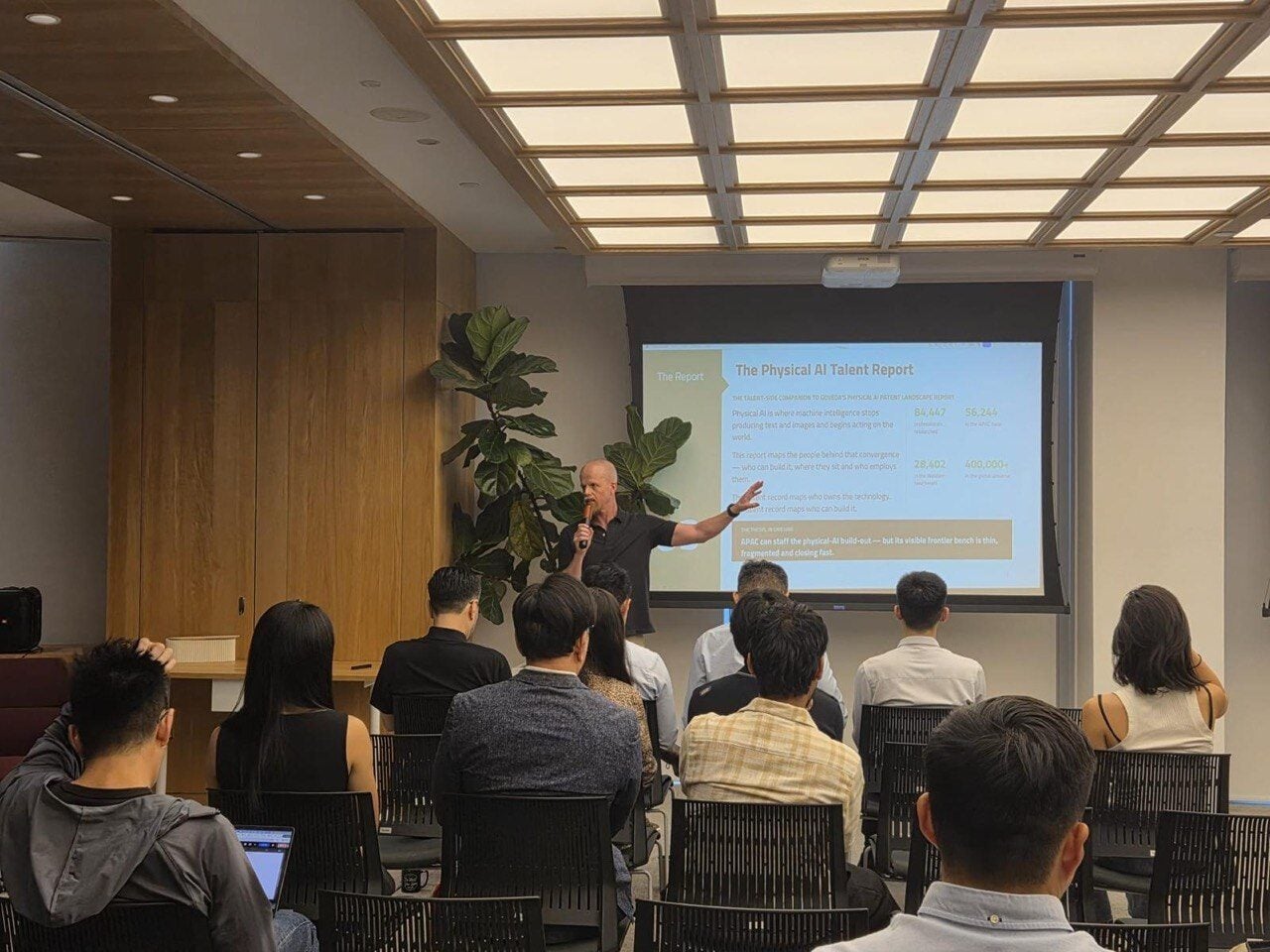
Physical AI is where machine intelligence stops producing text and images and starts acting on the world. The question every organisation entering that field runs into is not whether the technology exists, but whether it can be staffed. This session put two records side by side to answer it. GoVeda mapped who owns the technology across 240,333 patent families and 578 organisations. Olofsson mapped who can build it across 84,447 individually researched professional profiles, 56,244 of them across Asia-Pacific. Read together, the two records describe a field whose ownership is broad and still unconsolidated, and a workforce that is abundant at the base, almost empty at the apex, and unusually willing to move.
The report
Physical AI: The Patent and Talent Landscape
Launched at this session. Free, and emailed to you.
Get the reportWhy two records, and not one
A patent family is a record of an invention that has already been made. It is dated to a priority filing and published on a schedule running roughly eighteen months behind the work itself, which makes it excellent evidence of past capability and poor evidence of present capacity. The question facing anyone entering physical AI is prospective: not who invented, but who can now be hired to build, integrate, deploy and maintain machines that act in the physical world. That is a different question, answered by a different record. The session was built around putting both on the table at once, which as far as we know had not been done for this field before.
What the patent record shows
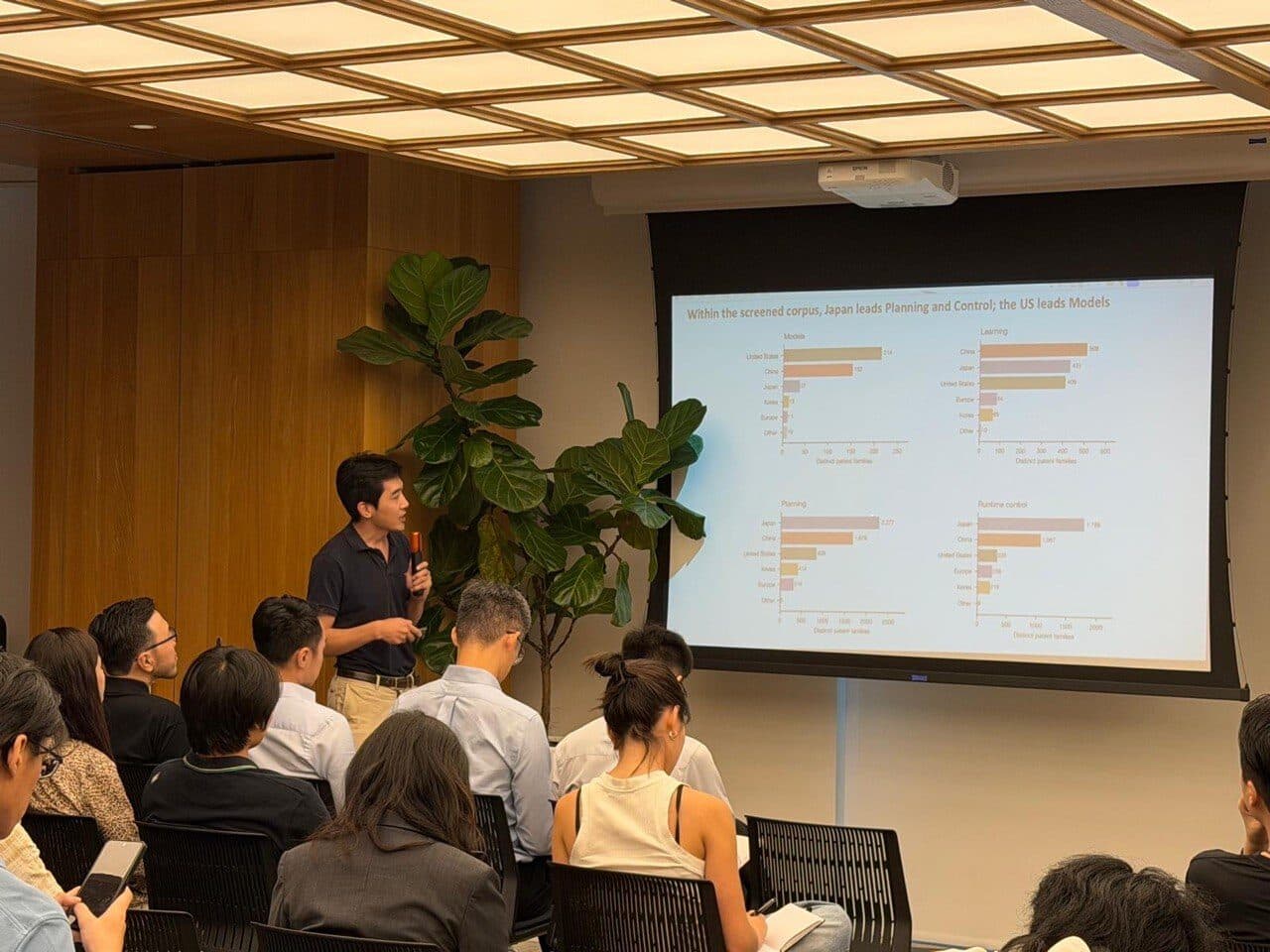
GoVeda's half of the study screened the corpus by content rather than by keyword and classification code, examining each candidate patent to identify its principal inventive contribution before placing it in the stack. The resulting picture is a landscape in transition. Japan holds the largest accumulated portfolio, built over decades of motor, actuator and transmission filing. The recent record, though, belongs to the Brain layers: China with by far the largest perception and learning portfolios, the United States with its weight in compute and in models, where world models and simulation sit. Power, thermal management and compute carry the highest recent filing shares in the whole corpus at 53, 48 and 42 per cent. And among robot integrators, several of the field's most highly valued developers hold few or no published families at all, which means something other than disclosed invention is being priced. Assembled teams are the obvious candidate.
What the talent record shows
Our half measured the supply side of the same stack: how many professionals document which skills, at which career stages, in which markets, trained where and employed by whom. The base divides cleanly by altitude. At the bottom the raw material is abundant, with 22,537 professionals documenting AI or machine learning and 16,508 documenting robotics. At the top the layers that will decide the next decade are nearly empty: 744 people touch embodied AI or robot learning, and 344 touch simulation. The buildable core sits in between, in the 5,323 engineers who combine robotics with AI or machine learning. They are hireable in volume, roughly half are open to an approach, and they are the fastest group to move up into the frontier layers.
Where the two records meet
The correspondences are close enough to be worth stating plainly. The layers the patent record assigns most decisively to the West, world models and simulation, are the two thinnest talent layers in Asia-Pacific. The perception and learning leadership the patent record finds in China has a visible shadow in the region's densest frontier bench, and an invisible one beneath it. And India, at 44 per cent of the mapped talent base, sits outside the patent record's five principal regions entirely, which is a reminder that the talent record covers ground the patent record does not segment at all. The two are built to different units and should not be added together, but read against each other they answer questions neither can answer alone.
What this means for hiring
Every finding in the session resolves into a hiring decision. Anchor on the crossover profile, because it is the only layer that offers both volume and a route upward. Treat embodied AI and simulation as individually mapped executive searches rather than pipeline exercises. Use India for scale and Singapore for deployment and leadership. Recruit out of the IT-services reservoir, which holds the largest pool of convertible AI talent in the region and is systematically under-priced against product peers. None of that is reachable through keyword search, which is the reason we built our own talent-intelligence platform: close to 500,000 professionals researched over eight years, which is what made a mapping of this depth possible in the first place, and what we run every search on.