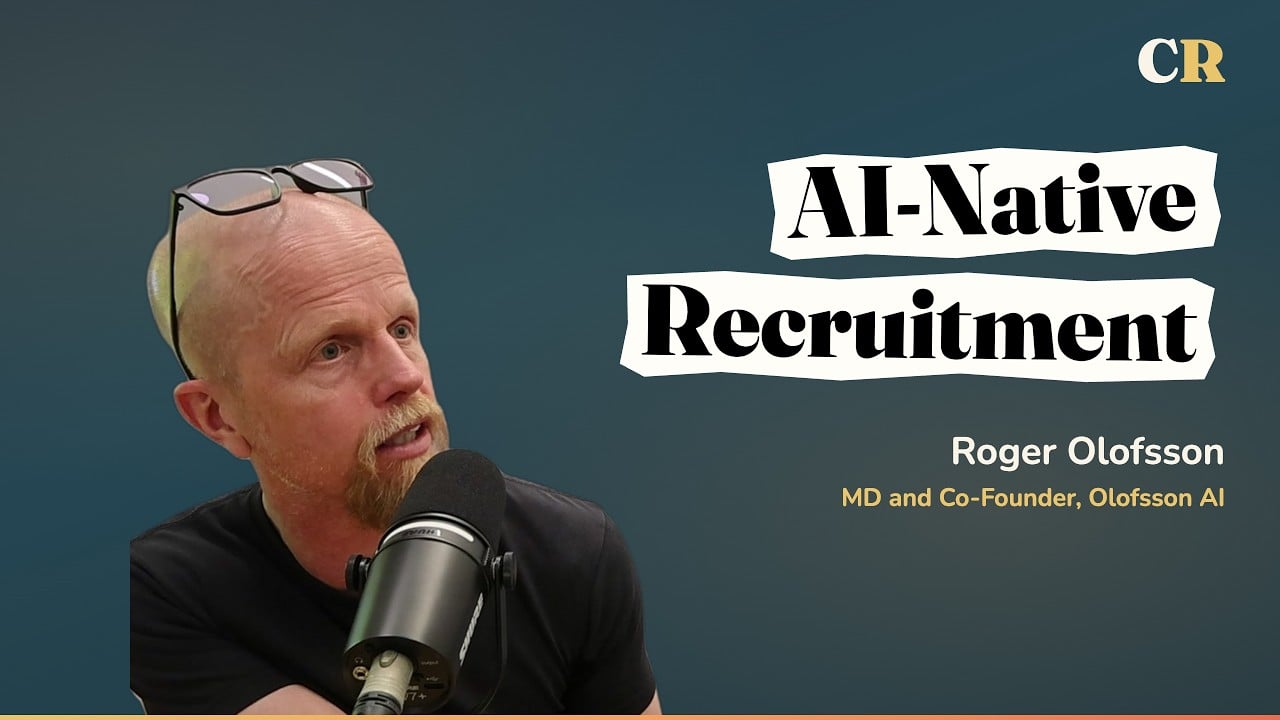
Code Riff is an interview show about how practitioners actually use AI, and for this episode hosts Eric Tan and Yaohong Ch'ng asked our CEO Roger Olofsson to open up the firm's stack on camera. What followed was an hour of specifics rather than positioning: a live demonstration of the matching platform running across 395,000 candidates, an honest account of why the team went all-in on frontier models instead of training their own, and the organisational work of getting thirty years of recruiting judgment into a system the whole firm now uses daily.
A live walkthrough, not a pitch deck
The centre of the episode is a screen share. Roger takes the hosts through the internal platform as it actually runs: the candidate database, the matching logic, and an agentic search proof of concept built on Exa, with the whole thing sitting on Postgres in Supabase and deployed on Vercel. Nothing about it is a demo environment. It is the system our consultants use to run live searches, which is why the hosts spend as much time on the unglamorous parts (how records are structured, where the judgment lives) as on the model layer.
Why language models changed what a search can reach
Traditional recruiting search is keyword matching, and keyword matching finds only the candidates who happened to describe themselves in the vocabulary the recruiter guessed. Roger's argument is that language models dissolve that constraint: the system reasons about what a profile means rather than which strings it contains, which surfaces exactly the candidates that were previously difficult or impossible to search for. For executive search, where the strongest candidates are often the ones not optimising their profiles for discovery, that difference is the entire game.
Removing the soul-draining work
Roger is direct about what the transformation was for: not headcount reduction, but removing the work that drains people. Agents now handle the endless scanning that used to eat a recruiter's afternoon, and the recovered time goes back into the parts of the job that require a person: reading a candidate properly, calibrating with a client, making the call. The episode covers how he got a team to adopt this without fear, which he frames as a question of aligning incentives for the long run rather than a training exercise.
Why the firm moved back into Claude Code
One of the more counterintuitive threads is the return to Claude Code after building custom software. Having gone through the cycle of building their own tooling, the team found that the general-purpose agentic terminal, plus a library of reusable skills kept in GitHub, covered more ground with less maintenance. Everyone in the firm now uses it, which is a considerably stronger claim than most companies can make about their AI rollout.
The roles this creates
The last stretch of the conversation turns to what AI-native operations do to job descriptions. Roger describes emerging roles that did not exist in the org chart two years ago, the agentic product manager being the newest, and makes the case that the technology is generating work as well as absorbing it. That is the same shift we see from the client side of our desk: the scarce hire is increasingly the person who can direct a system of agents rather than a team of analysts, and mapping that thin layer of the market is what our own AI platform is built to do.